Senate Enters Hour 14 of Historic Filibuster on Bill to Study Whether Filibuster Reform Needs a Study
Marathon Democracy in Action
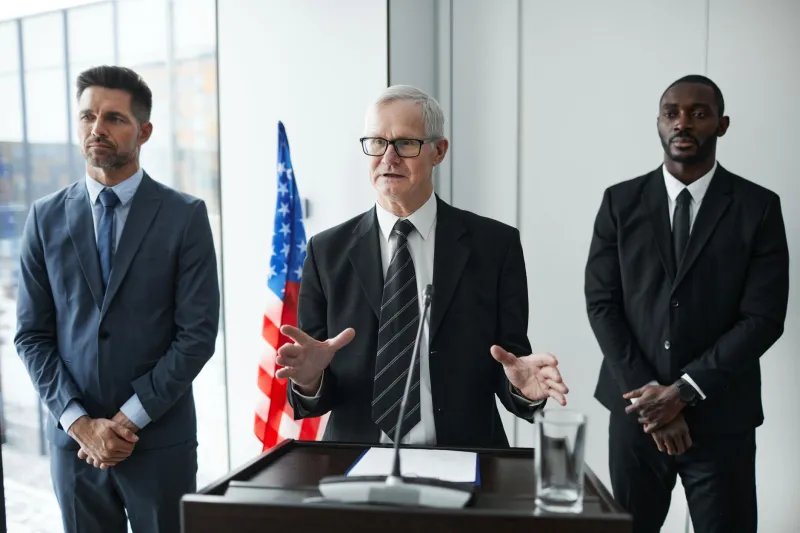
Senator Margaret Thornfield (R-Wyoming) has officially entered the congressional record books, surpassing the previous filibuster duration record while preventing a vote on S.B. 4471, the "Comprehensive Study Authorization for Potential Filibuster Reform Research Act." The bill, which would allocate $2.3 million to determine whether Congress needs to study its own debate rules, has now been successfully blocked by the very mechanism it seeks to examine.
 Photo: Senator Margaret Thornfield, via images.squarespace-cdn.com
"The irony is not lost on us," noted Senate Parliamentarian Dr. Edmund Blackwell, speaking from his office at 3:47 AM while reviewing centuries of procedural precedent. "We're watching a filibuster prevent a vote on studying filibusters. It's like democracy looking into a funhouse mirror."
 Photo: Senate Parliamentarian Dr. Edmund Blackwell, via d27790xjhw2fza.cloudfront.net
The Sears Catalog Gambit
Hour seven marked a turning point when Senator Thornfield, having exhausted her prepared remarks on the constitutional importance of unlimited debate, began reading verbatim from a 1987 Sears Christmas catalog discovered in the Senate cloakroom. The riveting description of a Kenmore washing machine's spin cycle features drew rare bipartisan attention from colleagues who had been pretending to listen since Tuesday morning.
"The senator's detailed analysis of holiday lawn decorations really drove home her point about preserving Senate traditions," observed freshman Senator Kyle Morrison (D-Oregon), who had initially planned to support the study bill. "By hour nine, when she reached the tool section, I began to understand the profound constitutional implications of cordless drill specifications."
C-SPAN programming director Janet Holbrook confirmed the network has received its highest overnight ratings since the 1991 Thomas hearings. "We've had to bring in additional camera operators," Holbrook explained. "Our usual crew wasn't prepared for a filibuster that includes detailed commentary on discontinued appliance warranties."
Procedural Innovation Reaches New Heights
Senate Majority Leader Harrison Webb (D-Delaware) attempted seventeen different parliamentary maneuvers to end the filibuster, including a rarely-used motion to "recognize the obvious futility of the current proceedings." Each motion was successfully countered by Thornfield's team, who cited obscure precedents dating back to the Tyler administration.
 Photo: Senate Majority Leader Harrison Webb, via biographyer.info
"We tried invoking the 'common sense clause' of 1923," Webb reported during a brief hallway press conference. "Turns out it was repealed in 1924 and nobody updated the rulebook."
The situation escalated when Senator Thornfield began reading her own previous filibuster transcripts, creating what constitutional scholars are calling "recursive democracy" – a parliamentary procedure that references itself in an infinite loop of bureaucratic self-awareness.
Expert Analysis Emerges
The Brookings Institution quickly assembled an emergency panel to analyze the filibuster of the filibuster study bill. Their preliminary findings, released via a hastily organized Zoom webinar, concluded that more research is needed to understand why Congress requires studies to study its own studying procedures.
"This represents a fascinating case study in institutional self-examination," explained Dr. Patricia Hendricks, Director of the Center for Democratic Processes. "We're witnessing the Senate use its own rules to prevent examination of those rules. It's democracy eating its own tail."
The Heritage Foundation issued a competing analysis arguing that the filibuster successfully demonstrated why filibuster reform is unnecessary, since the current system already prevents bad ideas like filibuster reform from advancing.
C-SPAN Breaks New Ground
Network executives report they've accidentally created the longest continuous broadcast of a single legislative session in television history. Marketing director Tom Klepper noted unexpected demographic engagement: "We're seeing viewership from college campuses using this as a sleep aid, and retirement communities treating it like a very long audiobook."
Production costs have exceeded $47,000 in overtime alone, though Klepper emphasized the historical significance justifies the expense. "Future civics classes will study this moment when American democracy achieved perfect circular logic."
The Working Group Solution
As dawn approached on the fifteenth hour, Senate leadership announced a breakthrough compromise: the bill would be tabled pending formation of a bipartisan working group to study whether a study of filibuster reform requires its own preliminary study.
"We've found a path forward that satisfies everyone's concerns about moving too quickly," announced Senator Webb, visibly exhausted but maintaining senatorial dignity. "The working group will spend six months determining the appropriate scope for the study that would inform the research into whether we need filibuster reform."
Senator Thornfield finally yielded the floor, noting that her demonstration had successfully proven the filibuster works exactly as intended. The chamber immediately adjourned for a long weekend, with most members heading directly to their cars without making eye contact.
Looking Forward
The working group is expected to convene sometime after the August recess, assuming they can agree on meeting logistics. Early discussions suggest they may need to form a preliminary committee to establish the working group's charter, pending approval from the Rules Committee, which is currently studying its own committee structure.
Constitutional scholars predict this cycle could theoretically continue indefinitely, representing either the pinnacle of democratic deliberation or its complete collapse into procedural performance art. As Dr. Blackwell noted in his final observation, "The beauty of the American system is that both interpretations are probably correct."