The Eyebrow That Governs: Inside the Small Office Where Senate Ambitions Go to Be Footnoted

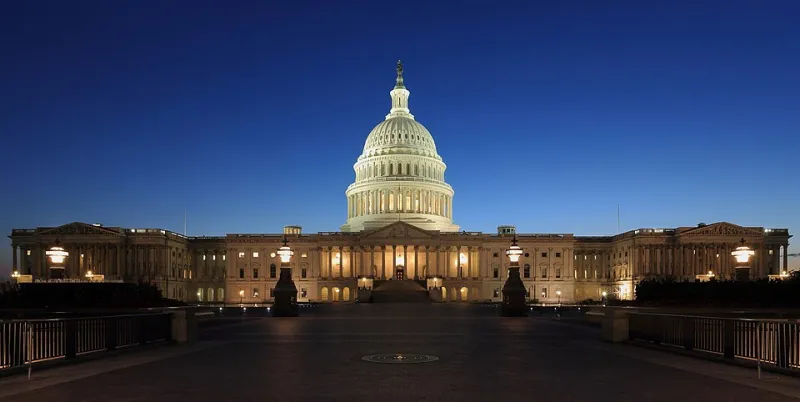
Photo: David from Washington, DC, CC BY 2.0, via Wikimedia Commons
In Washington, disasters are usually loud. Tornadoes get names. Hurricanes get a full week of cable coverage and a premium surcharge. Legislation, by contrast, tends to die quietly, one floor below the Senate chamber, in an office so small that the door has been described by visiting staff as "load-bearing."
That office belongs to Eleanor Finch, Senate Parliamentarian, thirty-one years on the job, unelected, unsackable, and — according to a growing body of anecdotal evidence — the single most effective killer of federal legislation in American history. Lobbyists dream of her influence. Super PACs budget for a fraction of it. Hurricanes, frankly, could not get a hearing on the schedule she keeps.
A Career Measured in Footnotes
Finch does not kill bills with votes, amendments, or drama. Her preferred instrument is the footnote — specifically, the small, numbered kind that appears at the bottom of a ruling most senators learn about from a press release.
The pattern is always the same. A bill emerges from committee with 87 cosponsors, a moving personal story from the lead senator, and a hashtag. It is scheduled for floor time. It is, by every human measurement, alive. Then a staffer walks down one flight of stairs, and comes back up with an expression.
"They never tell you it's the footnote," said Dale Kubiak, a former floor aide who served under four majority leaders. "You spend two years on a bill. You fight for the cosponsors. You do the CNN hit. And then it dies of a letter and a number. Fourteen, lowercase c, if you must know. I don't talk about fourteen c."
The Eyebrow
What Finch lacks in weaponry she makes up for in weather. Former aides universally describe her rulings in the tones normally reserved for meteorological events, and her raised eyebrow — visible, veterans say, from up to four desks away — has taken on an almost folkloric quality.
"You'd be down there making your case, laying out the argument of your career, and the eyebrow would go up maybe a sixteenth of an inch," said one former Senate counsel. "And you'd think: cold front moving in."
"It was like watching a glacier make a decision," said another. "You knew something had happened. You just wouldn't know what for six weeks, and neither would the senator."
Kubiak recalls watching Finch end a constitutional amendment debate with a pencil. "I've seen senators reduce grown men to silence. I've watched her reduce senators to silence with a pencil. She didn't even click it. That's what got me. She didn't click it."
Eleven Majority Leaders, One Rulebook
Finch's authority derives from her mastery of a rulebook last substantially amended in 1974, when its principal authors were alive, in office, and reportedly quite confident they had written something clear. She has now advised eleven majority leaders, each of whom arrived in Washington promising to restore power to the elected branch, and each of whom departed having ruled precisely nothing.
One majority leader, in 2003, attempted to overrule her on the floor. The episode — referred to in Senate lore only as "the incident" — ended after forty minutes and is not discussed by either party, both of which have since concluded that the rulebook means whatever she says it means, and that it has always meant that.
"We could override her tomorrow," a senior senator told this publication, before pausing. "We can't, though," he added, and left.
The Job Description
Perhaps the most remarkable fact about the most powerful unelected person in Washington is that her entire job description is one sentence: "The Parliamentarian advises the Presiding Officer on the interpretation of Senate rules and procedures."
There is no term limit. No qualification requirement. No line about eyebrows. Senate human resources describes the posting as "aspirational," which is also how it describes the Senate dress code.
Finch declined to be interviewed for this article, in keeping with an office tradition of silence that predates her tenure and will, reportedly, outlast it.
Technically Infinite
Finch's approval rating among senators is, by the standards of modern polling, a statistical marvel. Surveys have never recorded a single senator formally registering disapproval — largely because registering disapproval requires a procedure, which she would then rule on.
"By any polling methodology we use, her approval rating is infinite," said Dr. Marjorie Trimble of the Center for Applied Civics. "You cannot divide by her. We've tried. The math holds. The math always holds."
Nothing Will Change
When Finch eventually retires — her position, like her office, is described internally as "temporary," and has been since the Reagan administration — a successor will be chosen through the traditional process: the current Parliamentarian will issue a ruling.
The Senate is expected to accept.